Why talk therapy doesn’t always heal trauma? And how somatic therapy is different

Feeling Stuck in Talk Therapy
We’ve all been there…. spending weeks, months, even years in talk therapy and feeling like things haven’t really shifted all that much.
Sure we might have more tools under our belt.
Sure we feel validated in our experience in ways we hadn’t before.
Sure we may have gained a lot of self awareness. We know WHY we are the way we are.
And I don’t want to downplay how helpful and important these can be, because they really can shift a lot.
But therapy shouldn’t end there.
If we still struggle to feel calm, grounded, or regulated in our daily lives, what’s the point?
We are still reactive. We still have looping thoughts. We still feel the buzzing in our systems we now know as anxiety.
So what’s going on here? Why isn’t talking in therapy healing your trauma?
It’s because you’re busy talking about your problems, instead of connecting with the subconscious material causing your problems.
Where trauma lives in our nervous systems
When we engage in conversation or talk therapy, we are connecting with the youngest part of our brain, the neocortex (don’t worry, I won’t get too sciencey). This part of the brain is responsible for all of our higher and executive functioning like language, learning, decision making, voluntary movements, and more. For the most part, the is the part of the brain where we have conscious control.
But our bad habits, reactivity, and anxiety don’t always feel like they’re in our conscious control, right?
Well that’s because a lot of these less than ideal characteristics stem from trauma or impactful experiences that our brain has decided is important to remember. Trauma then creates an unconscious loop of behaviors and experiences where we are not fully in control. That’s why simply talking about these behaviors or lived experiences may not actually shift the experience itself.
This is because trauma lives in the oldest part of the brain. The part of the brain that is preverbal or beyond words. It is stored in the limbic system which includes the amygdala (fear center) and the hippocampus (memory). This is the part of the brain that activates fight, flight, freeze, or fawn.
So how do we connect with this part of the brain?
Why somatic and mindfulness based therapies can help?
Through paying attention to our somatic experience (ie. sensations in the body) we open up space for the limbic system to do the talking. Instead of talking about the anxiety or problem, we are in direct contact with it through deep presence and attunement.
As modern people, we are so disconnected from our bodies. And it’s not our fault. It benefits the larger systems at play (capitalism) for us to stay disconnected. But that’s a story for another day….
In bringing mindful awareness to our systems, it creates an environment for our trauma to unfurl in a safe and supportive container.
I love the analogy of a child throwing a tantrum. Oftentimes, all they want it attention. Sometimes our reactivity, shutdown, or anxiety are the same.
We don’t need someone telling us to think differently or reframe our thoughts. What we might need is to just pay compassionate attention to the anxiety. To give it space to breathe.
Through your body’s innate intelligence and sitting with a skilled and attuned therapist, what is stored in your system will slowly have space to come to the surface and hopefully…..be released. Freeing you of the behaviors and experiences that are keeping you trapped.
I’m not saying that it’s easy or that it’s some magic pill. This work is deep but I truly believe that folks have more capacity to hold their experience than they think they do.
Somatic therapy, mindfulness, and brainspotting all offer ways of doing so.
The unique role of brainspotting in healing trauma
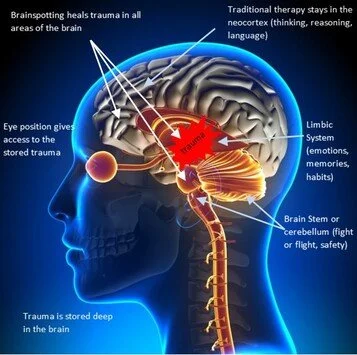
If you don’t know what brainspotting is, you can go here to learn more!
Brainspotting uses eye position to access stored trauma in the nervous system and body. As you can see our eyes provide a direct line to the limbic system through the ocular nerve. This creates a direct line of access to the information talk therapy takes years to get to.
Who is brainspotting good for:
Trauma (including complex or developmental trauma)
Anxiety
Grief
Wanting to change bad habits
Chronic Pain with possible psychosomatic origins
Performance Issues (like sports, singing, etc)
This is a therapy modality I offer to Washington State residents via online therapy. If you’re goals are more performance or expansion focused, I also offer a coaching version of this to people all over the world.
If you have any questions or curiosities, please reach out and let’s chat.
roya@royashalchisomatictherapy.com
There is hope for a different life (even if you’ve been at the self improvement game for years).